Showing posts with label Archie Goodwin. Show all posts

Monday, January 06, 2014

Murder Comes Up To Bat

Sometimes, you just want to sit back, relax, and take in the game. For Archie Goodwin and Saul Panzer, the sport of their choice is baseball. And so they venture out to the Polo Grounds to catch the Giants and the Dodgers battling it out. Of course, there’s a friendly bet on this game as with any other, and the winner will find himself being treated to an exquisite dinner at Rusterman’s Restaurant.

But this game isn’t quite like any other. There’s a notable guest in the stands, state senator Orson Milbank, who is at the Polo Grounds for Flag Day, enthusiastically supporting the American flag and getting some good publicity out of it. He needs all the publicity he can get, after losing many voters over some of his not-so-popular decisions. But apparently, he made one particularly bad enemy, because in the game’s fourth inning, the senator slumps over dead from a gunshot wound.

Monday, March 11, 2013

Not-so-funny funny books

Comic books are destroying the youth of America! Consider the evidence: they promote and glorify violence as a way of life. They actively promote racism and intolerance. Some comic books, such as the tales of Batwing and his young ward Sparrow, promote some of the ghastliest sexual perversions. And how do we know all this? Simple. Dr. Werner Frederick says so.

As a result, the comic book industry is in a tough place. Congress is getting set to examine the problem of comic-books and how they defile the moral fabric of America’s youth. Angry parenting groups are burning comic books and the industry is losing money. Enter Jack Starr, the Starr syndicate’s troubleshooter. Whenever trouble rears its ugly head, Jack has to go and take care of it, and Dr. Frederick’s passionate anti-comic-books crusade certainly qualifies… This forms the plot of Max Allan Collins’ Seduction of the Innocent.

Friday, October 26, 2012

Grand Finale

The last time we checked in at Nero Wolfe’s brownstone in The Second Confession, the great man was directly confronted by Arnold Zeck, a criminal mastermind who is something like the Professor Moriarty to his Sherlock Holmes. Luckily for Wolfe, soon afterwards, an event occurred that placed Zeck squarely on Wolfe’s side. But Zeck has gone too far this time.

It happens when Sarah Rackham asks for Wolfe’s help. She is a wealthy woman, and has been happily married to Barry Rackham for four years. In that time, Barry has regularly asked for money, but lately his demands increased so dramatically that Sarah finally refused to give him anything one time. After that, Barry no longer asked her for money, and yet his extravagant spending habits are unchanged. Where is all this money coming from?

Saturday, October 13, 2012

When Two Great Minds Meet

Whenever we walk into the brownstone of Nero Wolfe, we’re used to seeing everything in its place. Fritz is in the kitchen, doubtless making another fine dish for his employer. Theodore Horstmann is upstairs in the plant rooms, tending to ten thousand orchids. And when Wolfe isn’t up there himself, he’s in his office reading a book and attempting to ignore Archie Goodwin’s sarcastic digs, with the occasional cry of “Pfui!” But how did it all get there?

After all, Wolfe and Archie had to meet—what was that first encounter like? Were they working on a case together? What case was it? What did Archie do to impress Wolfe so much that something possessed him to hire the young man as his personal assistant, when their personalities are such polar opposites? To answer all these questions, Robert Goldsborough ended up writing Archie Meets Nero Wolfe, a prequel to Rex Stout’s famous series.

Sunday, September 30, 2012

Wolfe Steps Out

To set the plot of The Second Confession in motion, James U. Spurling, a wealthy industrialist, comes to Nero Wolfe’s brownstone and hires the famous detective to do a bit of tricky work for him. Spurling is convinced that his daughter Gwenn’s suitor, Louis Rony, is a Communist. Spurling asks Wolfe to prove this, but Wolfe decides it would be simpler to look for evidence that will convince Gwenn to drop Rony. And so, Archie Goodwin is sent down to the countryside to get some fresh air and do some undercover sleuthing.

But before you know it, Nero Wolfe gets a telephone call from Arnold Zeck, who introduced himself in the previous book in the series, And Be A Villain. Zeck demands that Wolfe cease the investigation, and when Wolfe refuses, Zeck arranges for some armed goons to shoot up Wolfe’s brownstone, completely destroying the plant rooms. This means war, and Nero Wolfe reacts to this threat by breaking one of his most sacred rules: he steps out of his house.

Thursday, April 19, 2012

All aboard the S. S. Van Dine!

I’m afraid that readers of this blog will begin to think that I’m simply stealing my reading list off of other blogs. Once again, today’s book was inspired by a previous review—and yet again, it was Bill from Traditional Mysteries who inspired it. The book is Murder in Pastiche by Marion Mainwaring, and after the enticing review Bill wrote in January, the book flew near the top of my to-be-read pile… and now that it’s April, I figured it was about time to give it a read. (Yeah, I’m not sure how to explain the physics behind that… Apparently, the last few months on this blog have been a massive game of Jenga with my to-be-read pile, and nobody was aware of it.)

But I digress. We find ourselves on board the R. M. S. Florabunda as it sails from Liverpool to New York. And, by an astonishing coincidence, nine prominent detectives have all come on board the same ship! These sleuths are parodies of some of the most famous detectives of all-time: M. Atlas Poireau (Hercule Poirot), Sir Jon. Nappleby (Sir John Appleby), Jerry Pason (Perry Mason), Broderick Tourneur (Roderick Alleyn), Trajan Beare (Nero Wolfe), Miss Fan Sliver (Miss Silver), Spike Bludgeon (Mike Hammer), Mallory King (Ellery Queen), and Lord Simon Quinsey (Lord Peter Wimsey). With any one of these detectives on board, a mystery is bound to explode— but with nine? That’s just tempting fate.

Wednesday, April 04, 2012

Enter Arnold Zeck

Nero Wolfe doesn’t enjoy work, but he is forced to do so by powers he cannot possibly control: the popularity of the series and the rate at which author Rex Stout’s pen flowed. This time, the International Revenue Service can be added into the mix. Wolfe needs to pay his income taxes, but he needs some more money. So after some prodding by his assistant Archie Goodwin, Wolfe sends Archie to offer his services as a private detective to Madeline Fraser, a radio talk show host who has gotten involved with a now-notorious murder case.

See, Miss Fraser did a bit of advertising on the radio not unlike the old Petri Wine plugs in the Sherlock Holmes radio plays. In these segments, she and her guests would open up bottles of a drink called Hi-Spot and drink it, all while eulogizing the merits of the drink. Nero Wolfe, whose palate revolts at such atrocities, insists Miss Fraser is a dangerous woman. But it’s all quite harmless… until one of the guests, Cyril Orchard, drinks some cyanide-laced Hi-Spot and dies during the live broadcast (ah, irony!).

Tuesday, December 20, 2011

Silence for the Murderer!

When are you guaranteed that an after-dinner speaker won’t be dull? Why, when he drops dead, of course, having gotten himself murdered! It’s what happens to Cheney Boone, head of a federal agency called the Bureau of Price Regulation (BPR). And while its opponents, such as the National Industrial Association (NIA) are rejoicing, Nero Wolfe sets out to find the killer.

This is for the excellent reason that Nero Wolfe’s bank is not particularly pleased to have him as a client at the moment... With the funds stretched to their limits, Archie pesters his boss until Wolfe accepts a high retainer from the NIA to discover the killer. How nice of the NIA— but the real motive for the hiring is that the NIA wishes to find the killer ASAP and stop the discrediting rumours about the organization.

Sunday, December 04, 2011

The Electronic Detective

I love this cover's simple elegance!
I’m an admirer of Rex Stout’s Nero Wolfe tales, which are some of the most fun I’ve ever had reading mysteries. I particularly love the narrative voice of Archie Goodwin, Wolfe’s assistant. The two are complete opposites: Archie’s a tough man of action and Wolfe is a lazy armchair detective—he quite literally refuses to budge anywhere.

It’s interesting to see what author Dave Zeltserman has written in the way of an homage to Wolfe. His detective, Julius Katz, is unlike Wolfe in many ways. He goes through rigorous exercises and martial arts training, for one thing. However, like Wolfe, he absolutely refuses to work unless he has to, and he also happens to be a gourmet (particularly when it comes to fine wines).

Both Zeltserman and Stout have one thing in common: Archie. But Zeltserman has come up with an absolutely brilliant, innovative variation on Archie Goodwin— Julius Katz’s Archie is not real. By that I mean Archie is not a person, but a supercomputer: a marvel of technology that Julius wears as a tie clip. Archie is designed to simulate human intelligence, and by observing his boss he hopes to one day solve a murder before he does.

Archie works with probabilities and logic, but that doesn’t stop him from nagging his boss Julius, in an eagerness to refine his neuron networks as often as possible. The e-book Julius Katz Mysteries is available for free, and all mystery lovers should take advantage of this offer. It collects two stories that were published in Ellery Queen Mystery Magazine—the first is more of a novella, while the second is more conventional short story length. Both, however, are great fun.

Saturday, October 29, 2011

He's been mostly dead all day...

Following Black Orchids, Not Quite Dead Enough is the second of the Nero Wolfe books that is not a novel. Again, Rex Stout gathers two almost entirely unrelated novellas and sticks them into one book; but this time, he feels comfortable enough with the form. In Black Orchids, Archie Goodwin writes brief prefaces to the stories and an afterword, which seem like an apologetic note trying to explain to readers what he is trying to do. There is no such thing going on in Not Quite Dead Enough.

The novella form seems to have brought out the best of Rex Stout. The plotting is tighter and more fast-paced, and the stories themselves are far more interesting. Some Wolfe novels would have worked so much better in this form, particularly (of those I’ve read) Fer-de-Lance, Too Many Clients, and Where There’s a Will. Each of these books is fun to read, but I’ll be darned if I remember much about the plots of those I haven’t read recently.

Wednesday, October 26, 2011

Mr. Wolfe Steps Out

I’ve been on a mission to read the Nero Wolfe books in as chronological an order as I can manage. The previous entry, Where There's a Will, was something of a disappointment: it wasn’t just flimsily plotted, but it seemed to lose interest in itself about halfway through. So when you compare it with the next book in the series, Black Orchids, the achievements of the latter seem even more impressive.

The structure of Black Orchids is completely different from any Nero Wolfe book that preceded it. It is not a novel but two novellas stuck together with only a tangential relationship between the two stories. The cast of characters is entirely different, and in fact, only the mention of black orchids gives the stories some common ground. Archie Goodwin himself must intervene and explain to the reader what he is trying to do. These stories are too long to be considered short stories, but they’re also far too short to be novels.

Friday, October 21, 2011

Dead Men Tell No Tales

I’ve recently been hired at the university library as a general shelver, and as a result, I now spend 13 hours a week at the library. I haunt the place to death anyhow, but the difference is I now get paid for it. To my delight, I discovered that the job wasn’t particularly formal—more casual—and I learned that if I felt so inclined, I could listen to audiobooks during my shift. I didn’t need to be prompted twice, and as a result, I listened to Rex Stout’s Where There’s a Will, finishing it in practically one day.

Noel Hawthorne was a very, very rich man, and when he died in a hunting accident, his family was consoled in the knowledge that they could comfort themselves with Noel’s money. What a shock, then, when they discover that Noel’s sisters (April, May, and June) get nothing but fruit— a peach, an apple, and a pear! Noel then left his wife a mere half million, and after some other legacies, the rest of the estate, about seven million or so, is left to his mistress, Naomi Karn.

Sunday, August 07, 2011

Come and be grilled...

There are a few reasons I omitted Rex Stout when I covered various forgotten Crime Kings. For one thing, reprints have been relatively kind to Stout, and Nero Wolfe and Archie Goodwin are still fairly popular, as evidenced by The Wolfe Pack. Heck, there’s even a recent, brilliant TV series based on the Wolfe novels! So I felt justified in putting Stout off, and probably wouldn’t have gotten around to reading him before I leave for Spain if not for Henry Wade’s Heir Presumptive, a book so brilliant it made elongating the Crime Kings series seem rather superfluous.

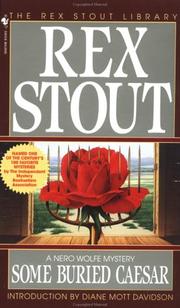
After making my initial acquaintance with Rex Stout’s work, I read a few randomly-chosen Nero Wolfe novels (including Champagne for One, Too Many Cooks, and Too Many Clients) before deciding it would be best to read the series chronologically. The last time I read a Nero Wolfe was the book Over My Dead Body, which was the result of an accidental error in my chronological shelving system. So at long last I’ve returned to the book I accidentally skipped: Some Buried Caesar.

Monday, June 20, 2011

XLVI. Where Quinn Booker and Lobo Blacke ride off into the sunset.

I have read only four novels by the late William L. DeAndrea, but I would be willing to put his name among the great GAD authors any day. DeAndrea wrote mystery novels with actual plots; he didn’t unnecessarily pad out his stories, which were solid ones, complete with clues and red herrings. Also, DeAndrea’s writing style was like that of the great Rex Stout: he captured the voice of Archie Goodwin and had it speak through the characters of Matt Cobb or Quinn Booker.

Written in Fire and Fatal Elixir were two books starring Quinn Booker and Lobo Blacke, who were rather like Archie Goodwin and Nero Wolfe transported to the Old West. Unfortunately, DeAndrea’s untimely death prematurely terminated the series, and it’s a real shame: reading Fatal Elixir, I could only shake my head, dismayed as I read what might have been…

Friday, May 06, 2011

The Big Chill

William L. DeAndrea has quickly become the most reviewed author so far on this (still rather young) blog, but can you really blame me? DeAndrea knew how to tell a good story without uselessly padding it out. He was clearly influenced by Rex Stout, and in this book, Killed on the Rocks, I noticed more than ever the way the detective, Matt Cobb, spoke in that unmistakable voice used by Stout’s Archie Goodwin.

Killed on the Rocks is a highly entertaining read, where DeAndrea seems to have combined the style of Rex Stout with a plot that John Dickson Carr at his most ingenious could’ve come up with. This combination is the stuff of dreams, something mystery fans like me thought they could only wish upon a star about. But as it turns out, it is possible to reach out and read it! No, this isn’t a hallucination, a lie, or a dream! Egad!