Showing posts with label historical. Show all posts

Wednesday, May 13, 2015

A Twist of Time

When Detective-Superintendent John Cheviot got into the twentieth-century taxi, nothing was amiss. “Scotland Yard,” he told the driver – meaning, of course, New Scotland Yard. He had no frisson of premonition, no encounter with a mysterious stranger… in short there was absolutely nothing to indicate anything unusual was about to occur. But when Cheviot got out of the taxi, he found himself at Old Scotland Yard… in the year 1829.

Cheviot finds himself part of Scotland Yard at its inception. The police are not seen as society’s protectors, but rather as a group of thugs with which high society needn’t bother. Apparently, everyone accepts Cheviot’s presence in 1829—perhaps he is re-enacting the historical role of an ancestor of his?—and it turns out that the original Cheviot was trying to join the newly-formed Scotland Yard.

Thursday, February 27, 2014

The Reader is Warned

There’s an old saying that the third time’s the charm. Having read two of Donald Thomas’ Sherlock Holmes continuations (The Secret Cases of Sherlock Holmes, Sherlock Holmes and the Voice from the Crypt), I was hoping that this saying would apply to the third of these collections, The Execution of Sherlock Holmes. Unfortunately, this was not the case.

My previous two Donald Thomas reviews went through each individual story, giving a brief plot summary and my opinion of the story in question, but I don’t much relish the prospect of doing the same with this book. So instead, I’ll go over the general premise of the book and just what has gone wrong.

Sunday, February 16, 2014

Tales from the Crypt

I had the great pleasure last year to read Donald Thomas’ The Secret Cases of Sherlock Holmes, a book which reimagined several famous murder cases as though they were Sherlockian adventures. My very favourite of the lot was an ingenious retelling of the adventure of Charles Augustus Milverton, revealing that it was a fictionalised account of the death of the notorious blackmailer Charles Augustus Howell, and turning it into a prequel to The Final Problem. It became one of my new favourite Sherlockian pastiches.

Naturally, I couldn’t pass up the chance to read more from this series, so I went with Sherlock Holmes and the Voice from the Crypt. It’s another collection of Sherlockian pastiches. There are six of them in all, but one of them is quite short, and the other (the titular story) is probably novella-length. As with the first book, Sherlock Holmes is called in to investigate famous mysteries, and helps the authorities behind-the-scenes. Naturally, Holmes doesn’t take any of the credit.

Wednesday, February 05, 2014

Let the Fire Fall

The year is 37 AD, and a young Roman nobleman named Sextus Marcellus Ennius is on a mission. His dying uncle, Pontius Pilate, has charged him with a task, a task he must complete if he wishes to inherit the estate: he is to discover the truth about a criminal who was executed a few years ago under Pilate’s authority. This man was reputed to possess supernatural powers, and his body disappeared after his death, apparently due to his resurrection. This has inspired a bizarre new religion, and Sextus must discover something to discredit its founder, Jesus-bar-Joseph.

So, accompanied by the Greek Freedman Eros Dion, Sextus travels to Jerusalem. There, they discover that Jesus-bar-Joseph’s middle years are virtually unknown. Nobody knows anything about his life from about age 12 to the beginning of his ministry. There can only be one logical conclusion from this: there must be something criminal or humiliating hidden in Jesus-bar-Joseph’s missing years, and Sextus must find it as soon as possible, in order to discredit this new god and laugh him off the face of the earth…

Monday, November 25, 2013

Band of Brothers

The time period is the American Civil War. As the fate of the United States is being decided on the front lines, heroes are born… and sometimes, good men falter. Such is the case with eight of the soldiers, court-martialed and convicted of cowardice. The military decides to conduct an unusual experiment, and gives these men their own separate company, Company Q.

Shunned and despised by their fellow soldiers, Company Q is led by Jared Heath, a former captain whose conviction came as a result of his refusal to obey a direct order. They’re nicknamed the Company of Cowards, and their unusual story is chronicled by Jack Schaefer, the author of the legendary novel Shane.

Thursday, October 17, 2013

If I Had a Million Dollars...

Max Allan Collins’ third Nate Heller novel, The Million-Dollar Wound, is very different from its predecessors. For one thing, it skips forward in time considerably. The previous book in the series, True Crime, took place in 1934. The Million-Dollar Wound opens in 1943. Nate Heller has returned to the States after fighting in WWII alongside his friend Barney Ross, but he returns a changed man.

Heller is brought back home from combat early because his testimony is wanted at an upcoming trial, one which could finally see Frank Nitti, Louis “Little New York” Campagna, and other gangsters on charges of extortion. But if there’s one thing Heller knows, it’s that double-crossing Frank Nitti is a very dangerous way of living, especially in Chicago, Nitti’s town…

Tuesday, September 24, 2013

Of Gangsters and Outlaws

Private eye Nate Heller is now in his second year of operations. His first year was described in detail in the novel True Detective, and all things considered it was a good first year. Unfortunately, Year Two has been much more quiet, with clients few and far between. After all, it is the Great Depression, and Heller has been watching the proceeds from his first year slowly dwindle…

And then he gets a case. It all starts when a shifty guy named John Howard comes to see Heller at his office. Howard is a travelling salesman who is worried that his wife, a pretty girl named Polly, is having an affair while he’s on the road. He pays Heller an exorbitant $100 in advance to follow Polly around and to determine whether or not she is being faithful. But right from the start it’s an odd job… and after a while, Heller finds that Polly is seeing a man all right… and that man looks remarkably like John Dillinger.

Thursday, September 19, 2013

The Resurrection of Sherlock Holmes

Donald Thomas’ book The Secret Cases of Sherlock Holmes is a rare treat, hitting upon a brilliant idea for a Sherlockian pastiche. As Dr. Watson explains in an introductory letter, Sherlock Holmes has died and his private papers have passed into the good doctor’s hands. These papers worry a good deal of important people, who would like to set fire to the documents on the spot. But after much bargaining, a compromise is reached: Dr. Watson is to have access to the papers and is allowed to chronicle some of Sherlock’s most secret cases. Afterwards, the stories (as well as Holmes’ papers) are to be suppressed for seventy years, to see the light of day only long after the principal players have all died.

And thus, Dr. Watson explains, this is the first time he dares to take up his pen and chronicle Sherlock Holmes’ most secret cases, completely uncensored and with no attempt to disguise the famous people involved in the mysteries. For instance, we learn that The Adventure of Charles Augustus Milverton was largely fictionalised in order to protect the identities of the persons involved – in reality, the notorious blackmailer was Charles Augustus Howell, who was found with his throat cut and a ten-shilling coin stuck in his mouth: the slanderer’s reward. Another of Holmes’ cases, mentioned in passing, involved a forgery case in which Holmes was of some service to Lestrade; Dr. Watson reveals that it was in fact the Bank of England forgeries of 1873, “when the Bidwell brothers came within a hair’s breadth of having the Bank’s funds at their mercy”.

Sunday, May 19, 2013

Tale as Old as Time

Inspector Alan Grant is sick in a hospital bed, through the magic of a plot device. (I believe it was a broken leg, but I don’t know why this would require such an extended stay in hospital.) Anyways, he is bored, bored, bored… with nothing to do, he is encouraged to take a look at some famous historical riddle and try to solve it from his bed. And so he becomes fascinated with the figure of Richard III, and decides to investigate whether the king really was the heinous killer of the Princes in the Tower.

It seems that everyone everywhere is in love with this book, and with Josephine Tey in general. Interest in Tey and this book surged with the discovery of Richard III’s bones. Because the ghost of Harry Stephen Keeler was still active in the blogosphere at the time, the news story hit just a few days after I’d finally purchased a copy of this book, intending to read it. But because a lot of people who had no idea what they were talking about suddenly became authorities on King Richard, Tey, and GAD in general, I decided to wait for a while.

Saturday, April 20, 2013

Dance of Death

Elementary, my dear Watson!
—apocryphal; attributed to Sherlock Holmes

The idea came to Robert Louis Stevenson in the form of a nightmare, according to his wife Fanny, and the first draft took only days to complete. Afterwards, she read the manuscript. As usual, she gave Robert her comments. After a while, he called her back to the bedroom and pointed to a pile of ashes: he had destroyed the manuscript and would start all over again from scratch. The story would eventually become The Strange Case of Dr. Jekyll and Mr. Hyde, one of the most celebrated stories of all of English literature.

But what if that manuscript survived? What if Stevenson never burnt it at all? What if the manuscript came into someone else’s possession? That is the situation created by RenĂ© Reouven in his book ÉlĂ©mentaire mon cher Holmes (Elementary, My Dear Holmes). And in this novel, we learn that the first draft of Dr. Jekyll and Mr. Hyde is a manuscript of such concentrated evil that anyone who reads it becomes a murderer…

Thursday, April 18, 2013

A Most Mysterious Murder...

Le DĂ©tective VolĂ© (The Stolen Detective) by RenĂ© Reouven begins with a disclaimer that goes something like this: “Edgar Allan Poe died in 1849, and Sherlock Holmes was born in 1854, but such a minute detail wouldn’t have prevented two such remarkable people from meeting.” This is a bit misleading, since there is never at any point in the novel a moment where Sherlock Holmes meets Edgar Allan Poe. And yet…

I will admit, the concept of this novel initially had me baffled. This is a Sherlockian pastiche in which Holmes’ fictional nature is admitted from the outset, and as a result the entire novel is a literary game being played out between Reouven and his readers. Here is the premise: Sir Arthur Conan Doyle is sick and tired of hearing all these comparisons between Edgar Allan Poe’s Dupin stories and his Holmes stories. So he uses H. G. Wells’ time machine to send Holmes and Watson back in time to Paris in the 1830s. Their mission is to get in touch with Vidocq, and investigate whether or not Poe ripped the idea for The Purloined Letter from the headlines. And if so, who was the real-life C. Auguste Dupin?

Saturday, March 23, 2013

All work and no play makes Jack a dull boy...

Katie Lennox is a teenager from modern-day London, and she wishes she were someone else. Her parents died in a tragic accident a few years ago, and so she left her native Massachusetts to live with her Grandma Cleaves in London. The only person left for Katie is her sister, but her band has recently hit it big and she has been spending all her time on the other side of the pond.

So one day, Katie goes to Madame Tussauds, where a Jack the Ripper exhibition is taking place. All of a sudden, she finds herself in a dress back in London of 1888. Katie decides to stay behind and find out just who Jack the Ripper is, and we’re off to the races. How hard could it be to discover the Ripper’s true identity? After all, Katie has seen plenty of CSI…

Wednesday, November 28, 2012

Rivers of Blood

The Wyvern Company were really no better than a group of medieval thugs. While on the warpath in France, the company sacked a French abbey and ran off with (among other things) the sacred Bloodstone ruby, allegedly collected from the blood of Christ while he hung on the cross. The ruby was given into the possession of Sir Robert Kilverby, a wealthy merchant, whose duty it is to produce the Bloodstone twice a year and who is safeguarding it until such a time as the Wyvern Company dies off.

That day might come sooner than expected, because somebody is murdering members of the Wyvern Company one by one. But Sir Robert Kilverby is also found dead, poisoned inside of a locked room. How was the crime committed? Lucky for us, Brother Athelstan investigates the matter, and in good time a second impossibility is thrown in the good brother’s face when a fire is started from inside of a locked room: how could the culprit have started the fire without waking the room’s occupant and without disturbing the locked door?

Thursday, November 22, 2012

Of Saints and Sinners

Deputy Art Oveson is a young man with a wife and two children. He also happens to be a devout Mormon, living in Salt Lake City in the 1930s. Although it’s nicknamed the city of saints, there is more to Salt Lake City than meets the eye. As clean and virtuous as its exterior may seem, it is a city with more than its fair share of crime and corruption, and pretty soon, Oveson finds himself smack in the center of it all.

It all begins when a wealthy socialite is found dead, brutally murdered by being repeatedly run over with a car. The late Helen Pfalzgraf was the wife of prominent physician Dr. Pfalzgraf, whose reputation as a doctor is nation-wide. The newspapers seize on the story and before long they are calling for someone’s head. Sheriff Cannon, who is heading the investigation, is an incompetent buffoon who is seeking re-election, and decides that the Pfalzgraf case is a top-priority matter—after all, if the case is solved quickly, it’ll be a feather in Cannon’s cap and will make his re-election that much easier…

Wednesday, April 11, 2012

Make way for the prince!

Getting involved in a murder investigation is serious business, especially if one happens to be heir to the throne. Yet that is precisely what Albert Edward, Prince of Wales – Bertie to his friends – does. Moreover, he approaches the challenge of detective work as marvellous fun, though the events he investigates are far from jovial. In fact, they are rather grim, as a famous jockey named Fred Archer (aka the Tinman) suddenly takes his own life with a revolver in the presence of his sister. The man’s final, frantic words were: “Are they coming???”

This mysterious allusion to some mysterious “they” is taken by everyone as part of the dead man’s delusions brought on by typhoid. After all, the poor man had been severely ill that weekend, and it isn’t inconceivable that the malady was typhoid. Yet Bertie is unconvinced—he himself suffered from typhoid, and Archer’s symptoms—or rather, lack of symptoms— seem most unusual. Bertie suspects that the whole thing is a well-intentioned cover-up in order to spare the family further grief.

Thursday, December 15, 2011

Then is the spectres' holiday - then is the ghosts' high noon!

When the spooks have a midnight Jamboree
They break it up with fiendish glee
Ghosts are bad, but the one that's cursed
It's the Headless Horseman, he's the worst.

—Brom Bones, Disney's The Legend of Sleepy Hollow

The most remarkable element of The Cup of Ghosts is how carefully researched it is. Paul Doherty constructs a fine narrative around true historical events (as he explains in his author’s note at the book’s conclusion). Someone really did die during the coronation ceremony of Edward II— Doherty tweaks it ever so slightly and turns it into a fine murder. Other people who really existed died within a short span of time, and Doherty plays the role of the Grim Reaper again by despatching them with murders, including one locked-room mystery. And Doherty paints a remarkable political picture of the times, as a subtle chess match is being played out between Philip of France and Edward of England.

Into it all Doherty casts Mathilde of Westminster, based on a real historical figure. She was living with her uncle, an influential Templar knight, when Philip of France moved to crush the order and seize its treasures. Mathilde’s escape was arranged— her uncle wasn’t so lucky. Mathilde is hidden in the best possible hiding spot—smack in the middle of the lions’ den, as Princess Isabella’s dame de chambre. Well, the two quickly forge a friendship, but it’s immediately tested severely. A string of brutal murders take place, and there are whispers that Edward of England might very well refuse to marry Isabella despite a French-English treaty. There’s discontent among the English Lords at the favour Edward shows to Lord Gaveston, and trouble in general is brewing.

Monday, October 17, 2011

The Dead Sleep Lightly

“When I was a boy, we used to light fires, a circle of bonfires around the village, to ward off the ghosts. Well, the ghosts have come back to Melford to haunt, to seek justice, perhaps even revenge. We not only deal with treasons of the living, Ranulf, but the treason of the ghosts.”
—Sir Hugh Corbett, The Treason of the Ghosts

I have shamefully neglected Paul Doherty’s tales starring Sir Hugh Corbett, but recent reviews by The Puzzle Doctor at In Search of the Classic Mystery Novel convinced me to give the stories a shot as soon as I could. But I decided to be a rebel and start with a title that sounded great instead of reading in strict chronological order. The result? I ended up picking up a copy of The Treason of the Ghosts.

It’s a really good title, isn’t it? And it’s adequately explained by Doherty in the quote I chose to open the review with. And the story itself is just as atmospheric as the title. The village of Melford is our backdrop. Five years ago, Sir Roger Chapeley was hung for a series of brutal rapes and murders. Now, however, the killings have started again, and the dead man’s son, Maurice, insists on an investigation. This brings Sir Hugh Corbett down to the village, and like a bloodhound, he begins to sniff around, catching the killer’s scent and relentlessly pursuing it.

Saturday, October 01, 2011

Sancta Maria, Mater Dei ora pro nobis peccatoribus...

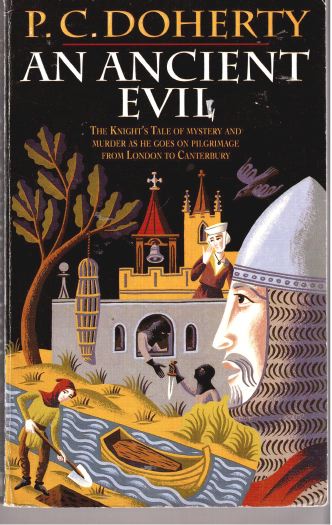
Paul Doherty’s An Ancient Evil was an excellent book, but it also set the bar for his “Canterbury Tales” series very high. This begs the question: would other books in the series rise up to the occasion, or would they fall short of the first book? However, being a foolish mortal, I skipped A Tapestry of Murders (Being the Man of Law’s Tale) and A Tournament of Murders (Being the Franklin’s Tale) and I went right to 1997’s Ghostly Murders, Being the Priest’s Tale.

Ghostly Murders is told by the Poor Priest, and the introduction is bone-chilling, as we see the Spectantes (“Watchers”) and hear them chant their ominous words to the priest: “Spectamus Te! We are watching you!” As in An Ancient Evil, the priest is prompted to tell his story, and as he goes on, we get more and more hints that this story really took place.

Friday, September 30, 2011

"Beware the Jabberwock, my son! The jaws that bite, the claws that catch!"

Welcome once again to a special edition of At the Scene of the Crime! As you probably know by now, I am celebrating my 100th blog post with an extravaganza of crossover reviews, joined by various other mystery bloggers. Today, The Puzzle Doctor has kindly joined me from his blog over at In Search of the Classic Mystery Novel. In fact, it was this same mathematician who, back in July, posted an enticing review of Nightshade by Paul Doherty. That post started an avalanche of Paul Doherty reviews in the mystery blogging community, and I was intrigued from the get-go. At the time, I commented:

“Ok, not fair. After plenty of talks with Curt Evans, here I am with a huge list of books by guys like R. Austin Freeman and JJ Connington, and here you go intriguing me with a completely different book!”

But if you scroll down just a wee bit, you’ll find another comment by John from Pretty Sinister Books, who wrote the following: “I also like the Canterbury Tales series especially since they show Doherty’s proclivity for the inclusion of supernatural elements in a detective novel. AN ANCIENT EVIL is one of the most frightening books about the vampire cult in old Romania I have ever read.”

This intrigued me: a series of mysteries centered on The Canterbury Tales, with supernatural elements? And that comment on An Ancient Evil from such a prolific blogger was too fascinating to resist... So it seemed like an ideal book to read and review with The Puzzle Doctor (a.k.a. Steve), who is responsible for this Doherty craze in the first place.

Steve, the crime scene is all yours! Thank you for joining me!

Thursday, September 29, 2011

By Hook or By Crook

Welcome back, good readers, to the scene of the crime! As part of my 100th post celebrations, I’ve lined up a series of crossover reviews with other bloggers, readers, etc., and today, blogger extraordinaire TomCat joins me from his blog Detection by Moonlight.

The first question, of course, was what to review. Perhaps a book by John Dickson Carr? But then again, I read Carr only every once in a while now, to delay the inevitable day when I read all his known work. I haven’t read much Margery Allingham, but although I enjoy her work, TomCat most emphatically does not. Well, there’s always a book by Paul Halt—er, wait a minute… TomCat doesn’t know French…

And then TomCat came up with a great idea, which can be traced to the Puzzle Doctor’s recent reviews over at In Search of the Classic Mystery Novel. Earlier this year, this rogue mathematician wrote an exciting and enticing review on Paul Doherty’s Nightshade, and several other reviews followed. I went down quickly without much of a struggle, eagerly lapping up The Devil’s Domain before leaving for Spain. TomCat succumbed to temptation as well, reviewing The Horus Killings and The Anubis Slayings, novels from Doherty’s Ancient Egypt series starring Amerotke, Chief Judge of Thebes.

I had yet to be initiated into Doherty’s Ancient Egypt series, so The Mask of Ra, first in the series, seemed like a good book to review (particularly after the Doc’s enticing review on his blog—again, it was TomCat’s idea). What is the secret behind Doherty’s work, so that several bloggers have expressed admiration for it in recent weeks? How do his characters hold up? Can he spin another impressive impossible crime set in the past? All this and more will be answered today!

Thank you for joining me today, TomCat!

***