Showing posts with label Dr. John Thorndyke. Show all posts

Saturday, September 10, 2011

So Long, My Sweet

Earlier this year, I attempted to struggle through Raymond Chandler’s The Long Goodbye and failed. The book started off well, but at the point at which I gave up, the plot was going nowhere, you could see the ending coming for miles ahead, and it was so overly padded that I simply couldn’t face the prospect of finishing the book. I put it down, wrote a harshly negative and sarcastic series of comments, and concluded that, after all, Raymond Chandler couldn’t write, and his stories were no more realistic than those he blasted in his famous essay The Simple Art of Murder.

So perhaps it’s only fair to give Raymond Chandler another go. My motives were not entirely altruistic; I’ve been preparing to paint my room, putting all my books into boxes and the like (which, by the way, resulted in my desk falling apart yesterday, which will make a lovely start to the school year). So I’ve been listening to an audiobook, and Chandler’s Farewell, My Lovely was the only one of his I could find which I hadn’t read yet. I had no intention of returning to the frankly incompetent The Big Sleep, and my thoughts on The Long Goodbye are already well-known.

Wednesday, August 03, 2011

Dr. Thorndyke Speaks

In the last few weeks, I’ve examined various Crime Kings and have quickly developed quite a liking for the work of R. Austin Freeman, creator of Dr. John Thorndyke. I loved The Eye of Osiris and the short story collection The Singing Bone, both of which are, in my humble opinion, masterpieces.

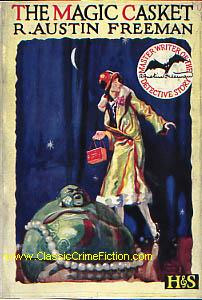
So I approached the short story collection The Magic Casket with plenty of optimism, hoping for something that would continue the brilliance. As it turns out, The Magic Casket is not a particularly brilliant short story collection, but it is a solid one, with some fairly good stories and interesting forensic techniques through which Dr. Thorndyke solves his mysteries.

Wednesday, July 27, 2011

Enter Dr. Thorndyke

The inanimate things around us have each of them a song to sing to us if we are but ready with attentive ears.
— Dr. John Thorndyke, “The Echo of a Mutiny” (collected in The Signing Bone)

And thus we have returned to R. Austin Freeman. I launched this series of reviews last week with Freeman’s own The Eye of Osiris, devoted to various Crime Kings: male authors who wrote in the Golden Age of Detective Fiction and towards whom time has been extremely unkind. Freeman is an excellent case in point. At one point in time, he was a highly respected author, even earning praise from Raymond Chandler (no mean feat, that). Flash forward to the publication of Bloody Murder in 1972, and what does Julian Symons write about Freeman? “Reading a Freeman story is very much like chewing on dry straw.” And he hasn’t fared much better today, which just puzzles me. My confusion increased after reading The Singing Bone, a collection of short stories originally published in 1911, in which Freeman invented what is known as the “inverted detective story”—a technique that the television show Columbo excelled at. I was expecting an interesting experiment but not much more. But once again, Freeman surprised me and smashed the ball out of the park.

Thursday, July 21, 2011

Eye spy with my little eye...

Richard Austin Freeman, creator of Dr. Thorndyke
R. Austin Freeman is one of a group of writers that have collectively been labelled “The Humdrums”. They include prolific authors like John Rhode, Freeman Wills Crofts, and JJ Connington. Time has not been kind to them, as their books have become scarcer and scarcer to find. Often the price tags attached are ridiculous. These authors are often scorned by critics, and have an unfair reputation as writers so dull they couldn’t entertain a drunken fish. (I used this description in my review of John Rhode’s Death on Sunday, but it could easily apply to the “Humdrums” in general.) They actually had quite a following in their day. Raymond Chandler, for instance, surprisingly confessed that he enjoyed R. Austin Freeman’s work:

'This man Austin Freeman is a wonderful performer. He has no equal in his genre, and he is also a much better writer than you might think, if you were superficially inclined, because in spite of the immense leisure of his writing, he accomplishes an even suspense which is quite unexpected ... There is even a gaslight charm about his Victorian love affairs, and those wonderful walks across London ...'

This comes as something of a surprise from the same person who damned authors like Agatha Christie and Dorothy L. Sayers. And yet, it is somewhat understandable when you consider the painstaking scientific realism Freeman achieves through Dr. John Thorndyke’s investigations. (And boy, we sure know that Raymond really had a thing for realism...)

But is this all this “scientific realism” a positive point or a negative point about Freeman’s work? I think it’s a bit of both, as evidenced by his 1911 novel The Eye of Osiris. But to discuss why, I suppose I’d better start by describing the plot.