Showing posts with label short story collection. Show all posts

Thursday, February 27, 2014

The Reader is Warned

There’s an old saying that the third time’s the charm. Having read two of Donald Thomas’ Sherlock Holmes continuations (The Secret Cases of Sherlock Holmes, Sherlock Holmes and the Voice from the Crypt), I was hoping that this saying would apply to the third of these collections, The Execution of Sherlock Holmes. Unfortunately, this was not the case.

My previous two Donald Thomas reviews went through each individual story, giving a brief plot summary and my opinion of the story in question, but I don’t much relish the prospect of doing the same with this book. So instead, I’ll go over the general premise of the book and just what has gone wrong.

Friday, November 29, 2013

The (E-)Resurrection of a Master of Mystery

Edward D. Hoch was, quite simply, one of the biggest and best names in the mystery field for decades. He was also a rarity: an author who managed to make his bread and butter almost entirely through short stories, a form that is possibly more difficult to master than that of the novel. Hoch’s career was amazingly prolific, with hundreds of short stories to his name. Ellery Queen’s Mystery Magazine would not have been the same without its usual dose of Edward D. Hoch. In any anthology, Hoch could always be relied on to deliver a solid story. He was a terrific plotter: he could come up with fascinating situations, and then resolve them so elegantly that the reader could only stare in amazement at the work of a master craftsman.

So imagine my delight to discover that The Mysterious Press has brought out Hoch’s books in e-book form. Many of these are short story collections, but Hoch wrote a novel every once in a while, such as The Shattered Raven (which is among the books brought back into e-print). And one book in particular caught my eye: The Sherlock Holmes Stories of Edward D. Hoch, which collects all twelve of Hoch’s Holmesian pastiches. If any author out there could possibly do Holmes justice, it would be Hoch, and so I knew I just had to read this book.

Friday, March 15, 2013

007 Reloaded: Octopussy and the Living Daylights


Well, this has been a long journey, but they all must eventually come to an end. I’ve been making my way through Ian Fleming’s James Bond novels book-by-book, and have rediscovered old favourites and made new ones. I’ve finally gotten to read You Only Live Twice, the only adventure I had not yet read. And I concluded the novels a while back with my review of The Man with the Golden Gun.

However, James Bond refused to die there. One final book was published after Ian Fleming’s death, collecting the last James Bond short stories. The book was called Octopussy and the Living Daylights, and those two stories originally formed the entire book. However, over time two more stories were added to this book (which is sometimes published as Octopussy). For me this formed one final glimmer of excitement—when I originally read this book, I am fairly certain that there were only the two titular stories in the collection. (A few years ago when I first read these books, I must have gotten hold of an earlier edition.) So although I thought I had no more Bond to discover, it turns out I had two more adventures to read! So what did I think of these stories? Let’s get started.

Sunday, February 24, 2013

007 Reloaded: For Your Eyes Only

Today I will be reviewing the James Bond collection For Your Eyes Only story-by-story. This is one of only two short story collections involving James Bond, and this one contains only five stories. It’ll probably be best if I discuss my impression of the collection as a whole after I’ve reviewed the individual stories. So without further ado, let’s get started.

From a View to a Kill
This is far from Fleming’s most inspired story. It’s actually a pretty boring way to open the collection. James Bond investigates the murder of a secret service motorcycle rider. He was going on his usual route from SHAPE (Supreme Headquarters Allied Powers Europe) to his base when he was attacked and his secret documents were stolen. Bond doesn’t have much trouble finding the assassin, and you wouldn’t exaggerate much by calling the story a celebration of predictability. It’s just not all that creative nor interesting, especially when you consider that Bond’s previous adventure was the wild romp Goldfinger.

Monday, August 20, 2012

A Short List of Great Stories

What better way to end this unofficial week of Crippen than with a return to Peter Lovesey? Better still— a return to Peter Lovesey via a short story collection published by Crippen & Landru! Since there are a few of these collections, it took me a while to decide which one to read—and finally, I decided on Murder on the Short List.

However, as my readers can testify, I’m infernally lazy. There’s quite a few short stories to be found in this collection, but they can be rather short, and it’s difficult to describe them in detail without giving something major away. So instead, I’ll vaguely describe some of the situations that this short story collection will throw at you. Are you ready? Here goes:

A harp heist gone wrong. A parade of elephants that leads to murder. A hearing aid heist planned and executed by a group of geriatrics. An attempt to seduce Adolf Hitler. A woman about to commit suicide discovers a memorial dedicated to her. Bertie, Prince of Wales, solves a Christmastime murder. Sergeant Cribb catches a Jack-the-Ripper-like murderer. Cold War tensions explode in a high-intensity tennis match at Wimbledon.

Monday, May 28, 2012

Presenting The Great Merlini!

Clayton Rawson is a pretty well-known name from the Golden Age of Detective Fiction. A magician and a great friend of John Dickson Carr’s, Rawson gave us one of the all-time great debuts of detective fiction when he invented his detective, The Great Merlini, and took him on a wild journey as Merlini had to solve the mystery of Death from a Top Hat, a complex affair involving multiple impossibilities that The Great Merlini explains rationally. Not only is it a great debut, I consider it one of the greatest detective novels of all-time. Rawson followed that classic up with three further novels and a series of short stories. But darn it all, those short stories are so hard to find!

But then, last week, while browsing my Facebook account, I suddenly noticed an update from MysteriousPress.com! I gasped and made sure I was reading it right. Clayton Rawson was back in print! All his novels have been resurrected into e-books, but that wasn’t enough for the folks at MysteriousPress.com. By some miracle worthy of The Great Merlini himself, they managed to reprint Rawson’s Don Diavolo stories… as well as all the short stories starring The Great Merlini! And thus, I instantly went to Amazon and purchased three books, one of which is entitled The Great Merlini: The Complete Stories of the Magician Detective.

Would Clayton Rawson be able to match the ingenuity of Death from a Top Hat? Were these stories really worthwhile? How would The Great Merlini handle the impossible disappearance of a person from a phone booth, a challenge that the great John Dickson Carr failed miserably (in Scotland Yard’s Christmas)? What about those short-short stories? Reader, I present you my critiques of the stories found in this brand new e-book:

Saturday, February 04, 2012

Sherlock who?

Over the last few days at work, I’ve had the enormous pleasure of listening to The Memoirs of Sherlock Holmes as read by the brilliant Derek Jacobi. I listened to Jacobi reading The House of Silk last year and absolutely loved his reading: he made Dr. Watson sound intelligent and charming, and not a buffoon like Nigel Bruce admittedly did. (That doesn’t mean I dislike Nigel Bruce as Watson, I just don’t think he’s anything like the character Sir Arthur Conan Doyle wrote about.) I don’t think you could possibly find a better actor than Jacobi to read these stories aloud. He makes Sir Arthur Conan Doyle’s prose come vividly to life, so that each story, even if forgettable, becomes a fantastic auditory experience.

I was well-familiar with these tales and so I was reacquainting myself with them. I found that I enjoyed them all very much after all this time. Truly, Sherlock Holmes is a timeless character— I am revisiting these stories yet again, and every time, I find that I love Conan Doyle’s world! The stories only seem to get better with age.

There is one omission here: The Adventure of the Cardboard Box, which in the U.S. is included in His Last Bow, was not among the tales I listened to, so I decided not to review it. For other reviews of Holmes shorts, please take a look at The Puzzle Doctor’s site, In Search of the Classic Mystery Novel, where the doc is discovering the Holmes tales and finding out just how much he’s been missing out on!

Saturday, January 07, 2012

Having a Ball

A few weeks ago, the French-language Paul Halter forum exploded in excitement, as the modern-day Master of the Impossible Crime updated his French website with two new books: Spiral, a young adult novel, and La Balle de Nausicaa (Nausicaa’s Ball), a short story collection. I had recently reviewed La Nuit du loup (The Night of the Wolf) and was convinced Santa Claus had listened to my plea for another short story collection from Halter. When I went on vacation to end 2011, nothing more had been posted on the subject. Little did I know what was brewing…

I love this cover!!!
On December 27th, Paul Halter made the announcement that the book was available to order… from Amazon.com! This was an odd move— Halter, a flagship author of legendary publisher Le Masque, had chosen to go with Createspace, an American self-publishing service, to publish a French book! Fans in France were understandably upset, and when the book finally appeared on Amazon.fr, the item quickly became “temporarily out of stock”. When I got back on January 1st, I immediately ordered a copy for myself. After all, how couldn’t I? As a sincere, though not uncritical, admirer of Halter, I relished the opportunity to support his newest book by ordering a copy, and ironically, making it first available on Amazon.com made it far easier for me to do so!

So maybe I’m the first person in the world who has gotten to read his copy of Nausicaa’s Ball. Possibly not, but as I don’t see any reviews of it online, I’ll go ahead and give myself an award. Nausicaa’s Ball contains seven short stories by Halter, whose writing style is remarkably suited to the short-story form. Some of these stories are short, and others could be published as novellas. The title story had been published in Ellery Queen’s Mystery Magazine, but this is the first time it’s appeared in French as far as I know. Meanwhile, two of the stories included here were actually translated and included in the English edition of The Night of the Wolf, but they weren’t collected in the original French book. I’ve adapted my original reviews of these tales and included them in this post.

Now that we’ve gotten the background information out of the way, it’s time to dig into Nausicaa’s Ball and discover what gems are to be found in this collection.

Saturday, November 19, 2011

Continuing an Improbable Fiction

I very recently reviewed La Nuit du loup (The Night of the Wolf) by Paul Halter, where I noted that I was reading the original French edition. The French version and the English translation, published in 2007, contain significant textual differences. One story, Un Rendez-vous aussi saugrenu (An Appointment as Ludicrous) was dropped from the translation because it’s impossible to translate into English. Two more stories were then added to bring the grand total up to ten: L’Abominable bonhomme de neige (The Abominable Snowman) and Le Spectre dorĂ© (The Golden Ghost).

However, these stories have not yet been collected in French (although I sincerely hope that day is near). As a result, when I reviewed La Nuit du loup, I was unable to comment on these two tales which English-speaking readers can find in the translation. However, since my review, I have been fortunate enough to read these two stories, and so, I would now like to review them as an addendum to my earlier review.

Sunday, November 13, 2011

An Improbable Fiction

“Truth, I may remind you, is stranger than fiction.”
“Spare me that tedious lie. You are quoting the only paradox which unimaginative people ever succeeded in inventing. And it is not true. It is insidious propaganda on the part of cheerless souls who want to make fiction as dull as truth. … What we need is some fearless iconoclast who will come out boldly against this damnable tyranny, saying, ‘Fiction is stranger than truth.’”
— Henri Bencolin, The Lost Gallows

La Nuit du loup (The Night of the Wolf) is thus far the only short story collection written by Paul Halter, and it was also his first book to be translated and published into English (back in 2007). It’s a wonderful collection that brings together all sorts of stories: some set in modern day, some starring Dr. Alan Twist, and others featuring Owen Burns. Halter has written several other short stories that have been uncollected thus far, and there’s enough to warrant a second collection, which would be most welcome.

However, it’s important to emphasize that I have read and will be reviewing the original French edition of La Nuit du Loup. There are several differences between the English translation and the original book. For one thing, the French edition contains only nine short stories (although the back cover claims it’s eight), while the English translation features ten. One of the original short stories was dropped because it was impossible to translate into English, and two others were added to bring the total up to ten: L’Abominable bonhomme de neige (The Abominable Snowman) and Le Spectre dorĂ© (The Golden Ghost). Finally, the order of the short stories is fairly different, although both English and French editions end with the titular short story.

Saturday, October 29, 2011

He's been mostly dead all day...

Following Black Orchids, Not Quite Dead Enough is the second of the Nero Wolfe books that is not a novel. Again, Rex Stout gathers two almost entirely unrelated novellas and sticks them into one book; but this time, he feels comfortable enough with the form. In Black Orchids, Archie Goodwin writes brief prefaces to the stories and an afterword, which seem like an apologetic note trying to explain to readers what he is trying to do. There is no such thing going on in Not Quite Dead Enough.

The novella form seems to have brought out the best of Rex Stout. The plotting is tighter and more fast-paced, and the stories themselves are far more interesting. Some Wolfe novels would have worked so much better in this form, particularly (of those I’ve read) Fer-de-Lance, Too Many Clients, and Where There’s a Will. Each of these books is fun to read, but I’ll be darned if I remember much about the plots of those I haven’t read recently.

Wednesday, August 03, 2011

Dr. Thorndyke Speaks

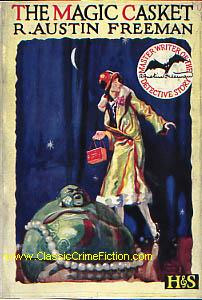
In the last few weeks, I’ve examined various Crime Kings and have quickly developed quite a liking for the work of R. Austin Freeman, creator of Dr. John Thorndyke. I loved The Eye of Osiris and the short story collection The Singing Bone, both of which are, in my humble opinion, masterpieces.

So I approached the short story collection The Magic Casket with plenty of optimism, hoping for something that would continue the brilliance. As it turns out, The Magic Casket is not a particularly brilliant short story collection, but it is a solid one, with some fairly good stories and interesting forensic techniques through which Dr. Thorndyke solves his mysteries.

Wednesday, July 27, 2011

Enter Dr. Thorndyke

The inanimate things around us have each of them a song to sing to us if we are but ready with attentive ears.
— Dr. John Thorndyke, “The Echo of a Mutiny” (collected in The Signing Bone)

And thus we have returned to R. Austin Freeman. I launched this series of reviews last week with Freeman’s own The Eye of Osiris, devoted to various Crime Kings: male authors who wrote in the Golden Age of Detective Fiction and towards whom time has been extremely unkind. Freeman is an excellent case in point. At one point in time, he was a highly respected author, even earning praise from Raymond Chandler (no mean feat, that). Flash forward to the publication of Bloody Murder in 1972, and what does Julian Symons write about Freeman? “Reading a Freeman story is very much like chewing on dry straw.” And he hasn’t fared much better today, which just puzzles me. My confusion increased after reading The Singing Bone, a collection of short stories originally published in 1911, in which Freeman invented what is known as the “inverted detective story”—a technique that the television show Columbo excelled at. I was expecting an interesting experiment but not much more. But once again, Freeman surprised me and smashed the ball out of the park.

Friday, July 22, 2011

Slaughterers Slip Up

Murderers make mistakes! … I should just think so! So many devise ingenious schemes to mislead the police and to avert suspicion from themselves: real brainy schemes which ought to succeed. And then they go and spoil them by some tiny oversight which gives the whole thing away, so that their guilt stands out a mile. It’s like a man who fits up an elaborate electrical system in his house: lights, fires, heaters; every conceivable gadget and convenience, and then spoils it all by forgetting to switch on the current.
—     Inspector French, The Case of the Lower Flat (collected in Murderers Make Mistakes

Freeman Wills Crofts is another one of “The Humdrums”, men whose books are too often scorned by critics, although they had quite a following in their day and have been rather influential in the genre.  Crofts seems to have had quite an obsession with seemingly perfect alibis and the way they are broken. Raymond Chandler called him “the soundest builder of them all when he doesn’t get too fancy”. Now, I disagree with Chandler on many points about the genre but he actually has a very good point there, which I will go further into as I take a look at Murderers Make Mistakes.

Murderers Make Mistakes is an interesting short story collection by Freeman Wills Crofts. These stories were originally radio plays, and the book makes no attempt to disguise it. It glories in the fact, giving you the original episodes and their broadcast dates. Eighteen radio plays from Chief Inspector French’s Cases (broadcast between 1943 and 1945) were converted into story form with varied degrees of success. In addition, five cases from Here’s Wishing You Well Again were converted into Inspector French short stories (the original detective being the coroner, Dr. Cataret). There are 23 stories in this collection, and I’m lazy, so once again, I won’t go through each story individually, but give you an idea of the collection as a whole.

Thursday, July 14, 2011

The Sound of the Basketballs

My casebook also records the name of the American barque John D. Carr, whose disappearance was a fortnight’s sensation, until Homes was able to accurately predict its exact location—in drydock—from a simple mathematical calculation and the word of the steersman that he had lashed the wheel before going over the side—a case I have already chronicled in The Adventure of the Locked Rhumb.
—Dr. Watney, The Adventure of the Missing Cheyne-Stroke

“I fear some grave misfortune may have befallen Sir Lionel Train.”
Homes nodded in instant understanding. “Who?” he inquired.
“Sir Lionel Train, head of Q6-JB45-VX-2DD-T3, the most secret of our secret services. Other than the Yard and Special Services, no one has ever heard of the man.”
“Ah! That Sir Lionel Train!” Homes said, and nodded.
—     Criscroft and Schlock Homes, The Adventure of the Great Train Robbery

I discovered my love of mysteries through Sir Arthur Conan Doyle’s Sherlock Holmes tales. So it’s hardly a surprise that, when I tired of reading juvenile mysteries, I turned to various pastiches to try recapturing the magic of Holmes. During that period, I encountered many parodies among the Holmes pastiches. I’ve seen Holmes portrayed as a complete buffoon, Watson the genius of the duo, Holmes as a figment of Watson’s imagination, and so forth. But over the last two days, I’ve had the intense pleasure of reading Schlock Homes: The Complete Bagel Street Saga, which is single-handedly the wittiest, funniest, most wildly entertaining, and (to put it simply) the best collection of Sherlock Holmes parodies I’ve ever read, collecting all the stories of Schlock Holmes, written between 1960 and 1981.

Schlock Holmes was a creation of Robert L. Fish, and I was inspired to find this book after reading Norma Schier’s brilliant The Anagram Detectives. Her final tale, The Boing! Ritual, is a riff on Schlock Holmes, who himself is a parody of Sherlock Holmes. Homes and his assistant, Dr. Watney, are pulled through some of the most astounding adventures, brought to them at their headquarters in 221B Bagel Street. On occasion, Homes’ brother Criscroft comes by to bring an interesting problem to his attention. (Invariably, however, there is something at Criscroft’s club preventing him from investigating himself.) Throughout the collection, Homes and Watney come across their archenemy, Professor Marty (whom they call—with good reason—The Butcher), several times.

Saturday, May 07, 2011

The Adventure of the Modern Short Story Collection

Wow, this is my third review in as many days. I’m almost surprised at myself. Anyhow, let’s get to the point: today’s review will be slightly different than usual, because I will be reviewing my first short story collection here, so I will be discussing each story individually and then look at them as a whole. Today’s book is by Hal White, author of The Reverend Dean Mysteries, a book which seems to have gotten considerably favourable reviews. I was intrigued: a modern-day author writing impossible crime stories starring a reverend? (Inconceivable!) I actually communicated with Mr. White through his website before placing an order on this book, and was reassured that the stories didn’t just go for unfair explanations. This encouraged me to order the book, and now I will share my opinions on these tales.