Showing posts with label supernatural. Show all posts

Monday, January 27, 2014

Let it Shine

Somewhere in the Colorado Rockies, there is an old and isolated hotel known as the Overlook Hotel. The season for tourists is now over and the hotel is ready to close up for the winter. Everyone will be back in May for the summer season, but until then, the hotel needs a caretaker to make sure that the hotel is in shipshape condition throughout the winter. And so a caretaker named Jack Torrance is hired.

Jack, his wife Wendy, and his young son Danny all come to the Overlook, preparing to spend the winter together. Jack is a struggling writer, and he intends to work on his play and finally get it finished. But the Overlook is not a good place – years ago, another caretaker named Delbert Grady was hired for the winter… and ended up murdering his wife and two daughters before committing suicide. It’d be silly to talk about ghosts, of course… but what about those apparitions that young Danny has seen? What about those sinister hedge animals which sometimes seem to come to life? What about those odd noises, as though a party from 1945 has never quite wrapped up? And why do these phenomena keep getting stronger, and increasing in intensity?

Saturday, January 25, 2014

Dead Poet's Society

The scene is first set in Victorian London. The black-hearted magician and spiritualist Jonathan is in London on a quest to end all quests. He seeks the throne of Solomon. Why on earth would he do that? Well, perhaps it’s best to quote from the author’s preface:

History and legend, scripture and fable have all ranked Solomon as the wisest and wealthiest of kings. But it is within the occult lore of both east and west that one finds mention of the darker side of Solomon, for he is said to have commanded spirits, demons and evil forces to obey his every wish. Of all his treasures, none was the equal of his throne, a marvel surpassing any treasure owned by all of the world’s monarchs. … It is said that books showing the evocation and control of devils are buried beneath the throne and he who possesses the throne possesses more than all of the riches of the greatest sovereign who ever lived. He possesses power equal to that of Satan and rivalling that of God.

The prize is enormous, and so are the stakes. Jonathan follows a lead to New York City, a city of the worst kinds of slums and poverty. But someone is on his tail, looking for revenge. That someone is Pierce James Figg, a boxer well-trained in various arts of combat. Figg wants to murder Jonathan to avenge his wife, who was killed by him. But once Jonathan flees to New York, Figg cannot continue his quest alone. He gets help from Charles Dickens in the form of money and a letter of introduction to an American who can help him track Jonathan down… a certain Mr. Edgar Allan Poe…

Thursday, January 23, 2014

Do as I do, Mr. Splitfoot!

Lucinda had a wonderful idea for a prank. To pull it off, she needed the help of an accomplice, so she enlisted the help of Vanya. The two teenagers decided to pull off a much-deserved scare on the grown-ups, faking supernatural activity. Vanya has a secret hiding place (which he refuses to disclose to Lucinda), and he’ll be hiding there. Upon a verbal cue from Lucinda, Vanya will make series of ghostly raps in reply. That’ll be sure to scare ‘em.

Sure enough, that evening, Lucinda finds an opportune moment and calls out “Do as I do, Mr. Splitfoot!” and claps her hands three times. She gets the reply: three taps sound in reply. It’s unsettling to the adults, and she is ready to call the prank a success… which is when she gets the phone call from Vanya. He’s been kept at home and is unable to play the part of Mr. Splitfoot this evening! But if Vanya was not making the ghostly taps… who was?

Thursday, November 21, 2013

Blackbeard's Revenge

…And unmoor’d souls may drift on stranger tides
Than those men know of, and be overthrown
By winds that would not even stir a hair…
—William Ashbless

John Chandagnac is off to the New World aboard the Vociferous Carmichael. He has only one thing in mind: he wants to find his uncle, Sebastian Chandagnac. But this will not be a happy family reunion. It turns out that Sebastian Chandagnac is a ruthless criminal. He claimed that his poor brother, the rightful heir to a fortune, was dead, and made off with the cash. That brother, John’s father, was a puppeteer, and ended up dying a pauper, from starvation and the cold. John is furious and wants to get to his uncle, reclaim the fortune that rightfully belonged to his father, and get even.

But you know what they say about the best-laid plans. John’s plans for revenge are suddenly halted when his ship is attacked by a gang of pirates, led by the infamous Philip Davies. And they weren’t working on their own: a few of the Carmichael’s passengers were in league with the pirates, helping them to take over the ship. One of these is Benjamin Hurwood, an eccentric one-armed professor with a beautiful daughter named Beth. When Davies murders the Carmichael’s former captain, Chandagnac, in a fit of fury, attacks the pirate and wounds him. As a result, Davies allows the other passengers to go free, but John Chandagnac is given a different choice:

“Join us, wholly adopt our goals as your own, or be killed right now where you stand.”

Friday, April 12, 2013

The Adventure of the Sanguinary Count

I was never much of a fan of the idea of Sherlock Holmes meeting Count Dracula. The only thing they really have in common is that they were both popular characters written at around the same time period. Apart from that there’s nothing. They inhabit separate universes. Holmes is the ever-rational man who discounts all supernatural explanations as a matter of course, while the
world of Dracula is one of terror and superstition.

But somehow, Holmes vs. Dracula became a thing. There are plenty of takes on this throughout Holmesiana, and a quick Google search of “Holmes vs. Dracula” will turn up dozens of stories. And today I’m reviewing one of the very earliest – if not the first – examples of this kind of novel, Loren D. Estleman’s Sherlock Holmes vs. Dracula.

Thursday, April 11, 2013

Are You Afraid of the Dark?

Dracula is one of those immortal stories that pretty much any intelligent person knows, even if they haven’t read the story themselves. It’s right up there with Hamlet, The Strange Case of Dr. Jekyll and Mr. Hyde, and A Christmas Carol. I had read Dracula before, but for reasons I will clarify in a moment, I wanted to revisit the classic novel.

So, here’s a really brief overview of the story for anyone who doesn’t know it: Dracula is an evil vampire who leaves his native land of Transylvania to come to England. He wreaks havoc there, draining the blood of a young woman without being suspected… that is, until someone calls in Dr. Abraham Van Helsing, who realises that Dracula is behind it all.

Sunday, November 11, 2012

The Horror

MysteriousPress.com is introducing a new series of stories called Bibliomysteries. The concept of the series is relatively simple: these are all relatively short tales centered on some sort of deadly book, manuscript, etc. Four titles will be released on November 12th by some prominent authors: Anne Perry, C. J. Box, Jeffrey Deaver, and Ken Bruen all contribute a tale.

In Anne Perry’s The Scroll, the book that sets the entire plot in motion is the titular scroll. It all starts with Monty Danforth. He’s an employee at a used bookstore, and the owner just bought a large crate of books from an estate auction. At the bottom of the crate lies an ancient scroll, not included among the catalogue of items. Intrigued, Monty takes a closer look: it looks like an old scroll, and the language is unfamiliar. Monty decides to photocopy the scroll in order to get a translation done, but the photocopier refuses to do its job—although it scans other documents just fine. So he tries to take a picture… and the scroll shows up clearly on the picture, but the text has vanished.

Saturday, October 06, 2012

'Tis the eye of childhood / That fears a painted devil

Maciej Słomczyński
Joe Alex was the pen name of Polish author Maciej Słomczyński (1922-1998). His most famous accomplishment is that he was the only person in the world to translate the complete works of William Shakespeare – an accomplishment I mention because it is relevant to today’s review. Unfortunately, his translations have been criticized as unclear, unfaithful to the source material, and lacking “literary value”—whatever that is. Still, the accomplishment itself is an impressive one, and it is a work of Shakespeare’s – sort of – that lends his novel Jesteś tylko diabłem (You’re Only a Demon) its title.

I say “sort of” because the text in question is The Birth of Merlin, which although originally credited as a co-production between Shakespeare and William Rowley, most scholars nowadays agree that Shakespeare didn’t write any of it. Another reason I say “sort of” is because the book kicks off with the following quote of The Birth of Merlin, translated into Polish… and the lines I have highlighted are all condensed into the phrase “Jesteś tylko diabłem”.

Tuesday, September 18, 2012

An Air of Evil

Someone needs to buy Christopher Fowler a drink. I’d do it myself, except I’m not in the UK area. Here is a modern writer who understands that, generally speaking, a mystery is only as good as its story. And he comes up with a terrific plot idea in this one: Bryant and May and the Invisible Code. Two children are playing “Witch Hunter” outside a church, and decide that a sad-looking young woman is a witch. “So how are we going to kill her?” one of the kids asks. The woman then enters the church… and then, as the kids watch from the door, the woman drops to the ground, dead! Nobody approached her, and the CCTV cameras clearly show that she died alone.

Arthur Bryant gets to hear of this death from his doctor and is intrigued, but the Home Office refuses  to hand him the case. Instead, Oscar Kasavian calls Bryant and May to his office. Kasavian, it turns out, needs help. His wife has been going crazy of late—covering the mirrors in the house, talking to strangers on the street, and insisting that a coven of witches is after her life. Kasavian doesn’t understand what is going on, and he’s due to make a major speech in a week’s time. He asks Bryant and May to investigate his wife and try to help her—and if they succeed, Kasavian promises to stop trying to shut down the Peculiar Crimes Unit.

Wednesday, August 01, 2012

The Itsy Bitsy Spider...

Marvel Noir was a concept from 2009-2010, in which Marvel released a bunch of miniseries inspired by their popular comic books. But here’s the twist: these comic books are set in an alternate reality inspired by film noir! (As a big fan of film noir, this really piqued my interest.) This sounds like a great idea, turning superheroes into private eyes and going for a more realistic tone than the Marvel Universe. And so today I’d like to take a look at the mini-series Spider-Man Noir, which lasted four issues and was followed with a second Spider-Man mini-series, Eyes Without a Face.

In Spider-Man Noir, we find ourselves in 1933, during the Great Depression. We open on a helluva situation: J. Jonah Jameson has been shot in his office at the Daily Bugle, and when police break down the door, they find the masked vigilante known as “the Spider-Man” inside. They immediately assume that the masked man has murdered the newspaperman and open fire, despite Spider-Man’s protests that “this isn’t what it looks like”.

Tuesday, July 24, 2012

No Friendly Drop

I was bewitched—nay, downright seduced—by the blurb on the back of Sara Woods’ They Love Not Poison. I was promised a book that would serve as a sort of unofficial sequel to John Dickson Carr’s The Burning Court: a mysterious death via poison takes place and the culprit seems to be the reincarnation of a 300-year old witch! With such an awesome idea, how can you possibly go wrong?

Unfortunately, and it breaks my heart to say this, Sara Woods finds a way to mess it up. I was hoping that today I would be able to sing the praises of an obscure minor classic. Instead, I find myself shaking my head in disbelief. The book’s story seems like it couldn’t possibly fail: set in post-WWII England, it involves Woods’ series character Antony Maitland. While staying at a friend’s place in a small farming community, Maitland gets involved in serious matters when a neighbour’s wife dies. Although she’s been ill for a while, the doctor finds the death suspicious and refuses to sign a death certificate. The rumours say that a young girl in the household is the reincarnation of a 300-year old witch, and somehow is the person responsible for the murder. And into all this we get some stuff about a lost treasure…

Friday, January 27, 2012

Sherlock: The Hounds of Baskerville

As The Hounds of Baskerville opens, Sherlock Holmes is bored. He is pining for a proper case, when a man named Henry Knight drops in for a visit. As a young boy, he claims, he witnessed his father getting ripped apart by a monstrous hound on Dartmoor. He ran away in terror, although no corpse was ever found. After years of therapy, he has returned to the crime scene… but this does nothing to quell his terrors. Although Sherlock is initially sceptical, he becomes very interested after his visitor tells him, “Mr. Holmes, they were the footsteps of a gigantic hound!”

Thus, Sherlock Holmes and Dr. Watson are on the case, going to Dartmoor. There, they get onto the scent of top-secret military experiments at a place called Baskerville. And I won’t say any more about the plot. The writer is Mark Gatiss, who previously penned the somewhat-disastrous The Great Game. (One of these days I’ll watch it again and give it a proper review to voice all my issues with that episode.) However, this time Mark Gatiss outdoes himself. The Hounds of Baskerville, inspired by the infamous The Hound of the Baskervilles, is a pure delight from start to finish.

Sunday, November 13, 2011

An Improbable Fiction

“Truth, I may remind you, is stranger than fiction.”
“Spare me that tedious lie. You are quoting the only paradox which unimaginative people ever succeeded in inventing. And it is not true. It is insidious propaganda on the part of cheerless souls who want to make fiction as dull as truth. … What we need is some fearless iconoclast who will come out boldly against this damnable tyranny, saying, ‘Fiction is stranger than truth.’”
— Henri Bencolin, The Lost Gallows

La Nuit du loup (The Night of the Wolf) is thus far the only short story collection written by Paul Halter, and it was also his first book to be translated and published into English (back in 2007). It’s a wonderful collection that brings together all sorts of stories: some set in modern day, some starring Dr. Alan Twist, and others featuring Owen Burns. Halter has written several other short stories that have been uncollected thus far, and there’s enough to warrant a second collection, which would be most welcome.

However, it’s important to emphasize that I have read and will be reviewing the original French edition of La Nuit du Loup. There are several differences between the English translation and the original book. For one thing, the French edition contains only nine short stories (although the back cover claims it’s eight), while the English translation features ten. One of the original short stories was dropped because it was impossible to translate into English, and two others were added to bring the total up to ten: L’Abominable bonhomme de neige (The Abominable Snowman) and Le Spectre doré (The Golden Ghost). Finally, the order of the short stories is fairly different, although both English and French editions end with the titular short story.

Tuesday, November 08, 2011

"`Twas brillig, and the slithy toves Did gyre and gimble in the wabe..."

When I was a child, I spake as a child, I understood as a child, I thought as a child: but when I became a man, I put away childish things. For now we see through a glass, darkly; but then face to face: now I know in part; but then shall I know even as also I am known.
— 1 Corinthians, 13:11-12

Helen McCloy truly had wonderful talent. Earlier this year, I reviewed her first book Dance of Death. It had flaws, as many first mystery novels do, and although I liked the character of Dr. Basil Willing, I found his method of detection, which relies heavily on Freudian psychology, highly subjective. However, the book was overall a triumph, with a clever murder method, plenty of social commentary that still rang true over 70 years later, and a brilliant motive for the murder. All this made me eagerly anticipate reacquainting myself with McCloy and Dr. Basil Willing, and at last I’ve done so with her 1950 novel Through a Glass, Darkly.

Wednesday, October 05, 2011

You are cordially invited to dine with death

Killed in a locked room—what a way to go! And that’s precisely what happens to Harold Vickers, master of the impossible crime mystery, in Paul Halter’s La Mort Vous Invite (Death Invites You). What a bizarre crime! First, someone purporting to be Vickers sends two invitations. One is to a police officer, Simon Cunningham. The other is to a newspaper reporter, Fred Springer. They arrive, but Mrs. Dane Vickers insists there must be some sort of mistake: her eccentric husband locked himself in his study yesterday and hasn’t left since! However, when Vickers doesn’t answer to knocks at the door and something smelling like chicken is detected in the air, the door is forced open…

Vickers is sitting at a table prepared for three, face down in his food, his face and hands severely burned in bubbling-hot oil. The food is an exquisitely prepared meal… but where did it come from? It was still steaming when the door was opened, but nobody could’ve prepared anything in the kitchen without being noticed! Still more bizarre: the door to Vickers’ study was locked and his windows were shut and locked, with the shutters closed! To add to the crime’s strangeness, a pair of gloves is discovered at the crime scene as well as a goblet half-filled with water underneath the window. Don’t forget to point out that this case strongly resembles an unsolved murder from 1907, and that the dead man was planning to use the exact same scenario for his new book… And, heck, just for good measure, throw in a long-lost, similar-looking brother from Australia.

Tuesday, October 04, 2011

Dead Man's Chest

Bien qu’admirateur inconditionnel de Carr et amoureux sans frein de son art de conteur, je me dois de constater qu’aucun de ses ouvrages les plus réussis – je dis bien : aucun ! – ne contient la grandeur tragique des dernières pages de La Malédiction de Barberousse.

As an unconditional admirer of [John Dickson] Carr and unreservedly loving the art of his storytelling, I wish to ascertain that none of his most successful works – I mean it: none! – contain the tragic grandeur of the final pages of La Malédiction de Barberousse.

—Roland Lacourbe, preface to La Malédiction de Barberousse (Barbarossa’s Curse)
(My apologies to Roland Lacourbe if I have butchered his words beyond belief in an attempt to translate them into English.)

The story behind the publication of La Malédiction de Barberousse (Barbarossa’s Curse) is interesting. It was originally self-published by Paul Halter in 1986, and it won the Prix de la Société des écrivains d’Alsace-Lorraine. It introduced Dr. Alan Twist, who would star in the award-winning tour-de-force La Quatrième Porte (The Fourth Door) the following year. It would be published by Le Masque in 1995. It’s even shorter than La Quatrième Porte, and it’s an interesting look at Paul Halter’s imagination. That being said, there are a lot of flaws in this book as well, which seems to be taking a nosedive until it redeems itself with a stunning ending.

Saturday, October 01, 2011

Sancta Maria, Mater Dei ora pro nobis peccatoribus...

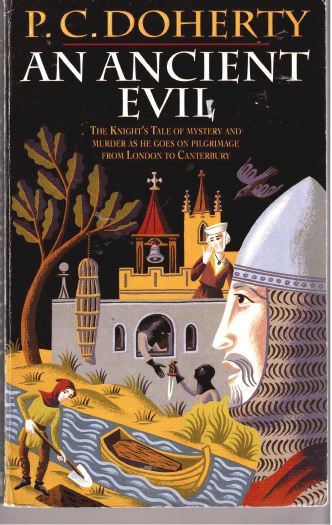
Paul Doherty’s An Ancient Evil was an excellent book, but it also set the bar for his “Canterbury Tales” series very high. This begs the question: would other books in the series rise up to the occasion, or would they fall short of the first book? However, being a foolish mortal, I skipped A Tapestry of Murders (Being the Man of Law’s Tale) and A Tournament of Murders (Being the Franklin’s Tale) and I went right to 1997’s Ghostly Murders, Being the Priest’s Tale.

Ghostly Murders is told by the Poor Priest, and the introduction is bone-chilling, as we see the Spectantes (“Watchers”) and hear them chant their ominous words to the priest: “Spectamus Te! We are watching you!” As in An Ancient Evil, the priest is prompted to tell his story, and as he goes on, we get more and more hints that this story really took place.

Friday, September 30, 2011

"Beware the Jabberwock, my son! The jaws that bite, the claws that catch!"

Welcome once again to a special edition of At the Scene of the Crime! As you probably know by now, I am celebrating my 100th blog post with an extravaganza of crossover reviews, joined by various other mystery bloggers. Today, The Puzzle Doctor has kindly joined me from his blog over at In Search of the Classic Mystery Novel. In fact, it was this same mathematician who, back in July, posted an enticing review of Nightshade by Paul Doherty. That post started an avalanche of Paul Doherty reviews in the mystery blogging community, and I was intrigued from the get-go. At the time, I commented:

“Ok, not fair. After plenty of talks with Curt Evans, here I am with a huge list of books by guys like R. Austin Freeman and JJ Connington, and here you go intriguing me with a completely different book!”

But if you scroll down just a wee bit, you’ll find another comment by John from Pretty Sinister Books, who wrote the following: “I also like the Canterbury Tales series especially since they show Doherty’s proclivity for the inclusion of supernatural elements in a detective novel. AN ANCIENT EVIL is one of the most frightening books about the vampire cult in old Romania I have ever read.”

This intrigued me: a series of mysteries centered on The Canterbury Tales, with supernatural elements? And that comment on An Ancient Evil from such a prolific blogger was too fascinating to resist... So it seemed like an ideal book to read and review with The Puzzle Doctor (a.k.a. Steve), who is responsible for this Doherty craze in the first place.

Steve, the crime scene is all yours! Thank you for joining me!

Tuesday, August 30, 2011

Night of the Lone Wolf

Le mardi, il y eut quatre brebis égorgées à Ventebrune, dans les Alpes. Et le jeudi, neuf à Pierrefort. « Les loups, dit un vieux. Ils descendent sur nous. »

L’autre vida son verre, leva la main. « Un loup, Pierrot, un loup. Une bête comme t’en as jamais vu. Qui descend sur nous. »

***

On Tuesday, four sheep were killed at Ventebrune in the French Apls. On Thursday, nine were lost at Pierrefort. “It’s the wolves,” a local said. “They’re coming down to eat us all up.”

The other man drained his glass, then raised his hand. “A wolf, Pierrot, my lad. It’s a wolf. A beast such as you have never clapped eyes on before. Coming down, as you say, to eat us all up.”

—Opening dialogue of L’homme à l’envers (“Seeking Whom He May Devour”)

When I was returning to Canada from Portugal, we took an Air France flight first to Paris and then to Toronto. At the airport, I found a bookstore/general newsstand and bought five books by French authors. Three of these were by Fred Vargas, a decision prompted by the intriguing summary on the back of L’homme à l’envers (meaning literally “The Inside-Out Man”, though a translation has been published with the inferior title of “Seeking Whom He May Devour”).

Thursday, August 04, 2011

Puzzle for Magicians

Jonathan Creek is a television series in which the titular character is a magician’s creative consultant, who manages to get himself mixed up in various impossible crimes, often with supernatural touches. The entire series was written by David Renwick, and much of it is very fun, even when it is flawed. And so, in 2009 and 2010, after a five year hiatus, Jonathan Creek returned to screen in a pair of full-length specials: the 120-minute The Grinning Man (New Year’s Day 2009 Special) and the 90-minute The Judas Tree (Easter Sunday 2010 Special).