Showing posts with label Paul Doherty. Show all posts

Wednesday, November 28, 2012

Rivers of Blood

The Wyvern Company were really no better than a group of medieval thugs. While on the warpath in France, the company sacked a French abbey and ran off with (among other things) the sacred Bloodstone ruby, allegedly collected from the blood of Christ while he hung on the cross. The ruby was given into the possession of Sir Robert Kilverby, a wealthy merchant, whose duty it is to produce the Bloodstone twice a year and who is safeguarding it until such a time as the Wyvern Company dies off.

That day might come sooner than expected, because somebody is murdering members of the Wyvern Company one by one. But Sir Robert Kilverby is also found dead, poisoned inside of a locked room. How was the crime committed? Lucky for us, Brother Athelstan investigates the matter, and in good time a second impossibility is thrown in the good brother’s face when a fire is started from inside of a locked room: how could the culprit have started the fire without waking the room’s occupant and without disturbing the locked door?

Wednesday, July 11, 2012

The Acquisitive Chuckle II: Return of the Chuckling

Hello everybody and I’d like to welcome you to another edition of me bragging about recent acquisitions of mine. This is the part of the show where I pretend to post in order to inflate my statistics, as well as taking advantage of an opportunity to just get up and brag about the newest additions to my collection. It’s been a long time since I’ve done this and there have been many acquisitions along the way—I wouldn’t be surprised if I managed to forget something along the way! So let’s get started.

Saturday, June 30, 2012

Satan is a Devil

Brother Anselm and his novice Stephen are summoned to St. Michael’s Parish. The church has been the site of recent hauntings, and the mysterious warlock known as the Midnight Man is blamed for a demonic midnight ceremony that opened the very gates of Hell on the parish. But as Brother Anselm explained, these (undoubtedly) supernatural phenomena must have a human cause—its root lies in the wickedness of a human heart. And so in order to weed out these demons, Brother Anselm must find the human cause of their wickedness. Stir in plenty of ghostly Gothic atmosphere, and don’t forget that impossible crime that takes place in a locked church. And ta-da! you have the plot of Paul Doherty’s The Midnight Man.

Paul Doherty’s latest effort is a return to his Canterbury Tales series, which is my personal favourite. The premise of this series is that the pilgrims of Chaucer’s Canterbury Tales have made an agreement that, at night, each of them should tell a story about the night-time, a story to chill the blood. (This time, it’s the physician’s turn, although there isn’t a physician appearing anywhere in the story.) And so, in these stories, the supernatural goes without question. God exists, and just as importantly, so does Satan—but their inclusion doesn’t mean that you can’t have a fairly clued mystery thrown into the works!

Thursday, December 29, 2011

Year in Review: Top 10 Discoveries of 2011

What better feeling is there than stumbling over an author you love? That moment of excitement, the thrill of the discovery, is one of many things that keep us readers going. We want to find an author who will excite us, and when we find one, we tend to hold on and refuse to let go.

2011 was no exception for me— I discovered new authors left and right and many of these discoveries were tremendously exciting. Some authors I unfortunately neglected despite the discovery, but I’ll be doing my best to make up for that in the New Year. But which discoveries were the most exciting? After all, it’s been a long year and there have been many book reviews. Surely some must stand out more than others.

Yes, it’s time for another list as I take a look at the ten most exciting literary discoveries I made in 2011. They are, in alphabetical order:

Thursday, December 15, 2011

Then is the spectres' holiday - then is the ghosts' high noon!

When the spooks have a midnight Jamboree
They break it up with fiendish glee
Ghosts are bad, but the one that's cursed
It's the Headless Horseman, he's the worst.

—Brom Bones, Disney's The Legend of Sleepy Hollow

The most remarkable element of The Cup of Ghosts is how carefully researched it is. Paul Doherty constructs a fine narrative around true historical events (as he explains in his author’s note at the book’s conclusion). Someone really did die during the coronation ceremony of Edward II— Doherty tweaks it ever so slightly and turns it into a fine murder. Other people who really existed died within a short span of time, and Doherty plays the role of the Grim Reaper again by despatching them with murders, including one locked-room mystery. And Doherty paints a remarkable political picture of the times, as a subtle chess match is being played out between Philip of France and Edward of England.

Into it all Doherty casts Mathilde of Westminster, based on a real historical figure. She was living with her uncle, an influential Templar knight, when Philip of France moved to crush the order and seize its treasures. Mathilde’s escape was arranged— her uncle wasn’t so lucky. Mathilde is hidden in the best possible hiding spot—smack in the middle of the lions’ den, as Princess Isabella’s dame de chambre. Well, the two quickly forge a friendship, but it’s immediately tested severely. A string of brutal murders take place, and there are whispers that Edward of England might very well refuse to marry Isabella despite a French-English treaty. There’s discontent among the English Lords at the favour Edward shows to Lord Gaveston, and trouble in general is brewing.

Monday, October 17, 2011

The Dead Sleep Lightly

“When I was a boy, we used to light fires, a circle of bonfires around the village, to ward off the ghosts. Well, the ghosts have come back to Melford to haunt, to seek justice, perhaps even revenge. We not only deal with treasons of the living, Ranulf, but the treason of the ghosts.”
—Sir Hugh Corbett, The Treason of the Ghosts

I have shamefully neglected Paul Doherty’s tales starring Sir Hugh Corbett, but recent reviews by The Puzzle Doctor at In Search of the Classic Mystery Novel convinced me to give the stories a shot as soon as I could. But I decided to be a rebel and start with a title that sounded great instead of reading in strict chronological order. The result? I ended up picking up a copy of The Treason of the Ghosts.

It’s a really good title, isn’t it? And it’s adequately explained by Doherty in the quote I chose to open the review with. And the story itself is just as atmospheric as the title. The village of Melford is our backdrop. Five years ago, Sir Roger Chapeley was hung for a series of brutal rapes and murders. Now, however, the killings have started again, and the dead man’s son, Maurice, insists on an investigation. This brings Sir Hugh Corbett down to the village, and like a bloodhound, he begins to sniff around, catching the killer’s scent and relentlessly pursuing it.

Saturday, October 01, 2011

Sancta Maria, Mater Dei ora pro nobis peccatoribus...

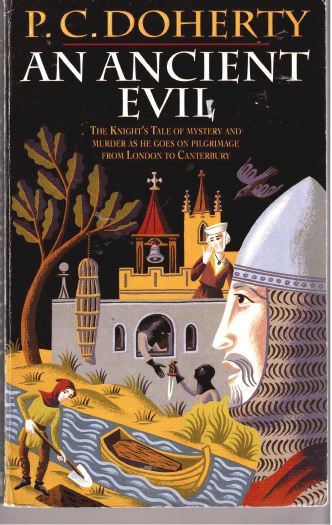
Paul Doherty’s An Ancient Evil was an excellent book, but it also set the bar for his “Canterbury Tales” series very high. This begs the question: would other books in the series rise up to the occasion, or would they fall short of the first book? However, being a foolish mortal, I skipped A Tapestry of Murders (Being the Man of Law’s Tale) and A Tournament of Murders (Being the Franklin’s Tale) and I went right to 1997’s Ghostly Murders, Being the Priest’s Tale.

Ghostly Murders is told by the Poor Priest, and the introduction is bone-chilling, as we see the Spectantes (“Watchers”) and hear them chant their ominous words to the priest: “Spectamus Te! We are watching you!” As in An Ancient Evil, the priest is prompted to tell his story, and as he goes on, we get more and more hints that this story really took place.

Friday, September 30, 2011

"Beware the Jabberwock, my son! The jaws that bite, the claws that catch!"

Welcome once again to a special edition of At the Scene of the Crime! As you probably know by now, I am celebrating my 100th blog post with an extravaganza of crossover reviews, joined by various other mystery bloggers. Today, The Puzzle Doctor has kindly joined me from his blog over at In Search of the Classic Mystery Novel. In fact, it was this same mathematician who, back in July, posted an enticing review of Nightshade by Paul Doherty. That post started an avalanche of Paul Doherty reviews in the mystery blogging community, and I was intrigued from the get-go. At the time, I commented:

“Ok, not fair. After plenty of talks with Curt Evans, here I am with a huge list of books by guys like R. Austin Freeman and JJ Connington, and here you go intriguing me with a completely different book!”

But if you scroll down just a wee bit, you’ll find another comment by John from Pretty Sinister Books, who wrote the following: “I also like the Canterbury Tales series especially since they show Doherty’s proclivity for the inclusion of supernatural elements in a detective novel. AN ANCIENT EVIL is one of the most frightening books about the vampire cult in old Romania I have ever read.”

This intrigued me: a series of mysteries centered on The Canterbury Tales, with supernatural elements? And that comment on An Ancient Evil from such a prolific blogger was too fascinating to resist... So it seemed like an ideal book to read and review with The Puzzle Doctor (a.k.a. Steve), who is responsible for this Doherty craze in the first place.

Steve, the crime scene is all yours! Thank you for joining me!

Thursday, September 29, 2011

By Hook or By Crook

Welcome back, good readers, to the scene of the crime! As part of my 100th post celebrations, I’ve lined up a series of crossover reviews with other bloggers, readers, etc., and today, blogger extraordinaire TomCat joins me from his blog Detection by Moonlight.

The first question, of course, was what to review. Perhaps a book by John Dickson Carr? But then again, I read Carr only every once in a while now, to delay the inevitable day when I read all his known work. I haven’t read much Margery Allingham, but although I enjoy her work, TomCat most emphatically does not. Well, there’s always a book by Paul Halt—er, wait a minute… TomCat doesn’t know French…

And then TomCat came up with a great idea, which can be traced to the Puzzle Doctor’s recent reviews over at In Search of the Classic Mystery Novel. Earlier this year, this rogue mathematician wrote an exciting and enticing review on Paul Doherty’s Nightshade, and several other reviews followed. I went down quickly without much of a struggle, eagerly lapping up The Devil’s Domain before leaving for Spain. TomCat succumbed to temptation as well, reviewing The Horus Killings and The Anubis Slayings, novels from Doherty’s Ancient Egypt series starring Amerotke, Chief Judge of Thebes.

I had yet to be initiated into Doherty’s Ancient Egypt series, so The Mask of Ra, first in the series, seemed like a good book to review (particularly after the Doc’s enticing review on his blog—again, it was TomCat’s idea). What is the secret behind Doherty’s work, so that several bloggers have expressed admiration for it in recent weeks? How do his characters hold up? Can he spin another impressive impossible crime set in the past? All this and more will be answered today!

Thank you for joining me today, TomCat!

***

Tuesday, August 09, 2011

Five Little Frenchmen

Recently on In Search of the Classic Mystery Novel, one puzzledoctor (aka Steve) has recently been dipping into the work of Paul Doherty. I was intrigued. How could an author of historical mysteries, who apparently kept his eye on the puzzle element as well as the historical, have slipped under the radar for me? I’d certainly never heard of him. But one book review followed another, until I finally went around a few used bookstores and bought three books by Doherty: The Cup of Ghosts, The Season of the Hyaena, and The Devil’s Domain.

I finally decided to read The Devil’s Domain and see just what there is to like about Doherty. The answer: a lot. This was definitely the right book to pick. It a historical mystery with clever clueing and a fast-paced, exciting plot… and also an impossible crime! As an added bonus, it’s an impossible poisoning! For some reason, you don’t see too many of those, probably because it’s kind of hard to come up with a way to make poisoning seem impossible. Still, when it’s done right, it’s a fantastic plot idea! See The Red Widow Murders or The Chinese Gold Murders for good examples.